Inclusive Guided Tour for Blind, Visually Impaired and Sighted Visitors of the exhibition, which focuses on the period between destruction and reconstruction – that uncertain moment when it is still unclear how societies will cope with loss, guilt and memory.
Wars, conflicts and the consequences of the climate crisis are destroying houses, cities and landscapes around the globe. Millions of people are losing their homes. Rebuilding these living environments is therefore an urgent task. However, if reconstruction is reduced to a technical undertaking – as a return to normality, a supposed “zero hour” or an opportunity for capital-driven investment – we lose sight of the fact that it is not only buildings and cities that are destroyed but also social relationships, ecological structures, shared ways of life and historical contexts. The crucial questions regarding reconstruction therefore arise before any building work begins.
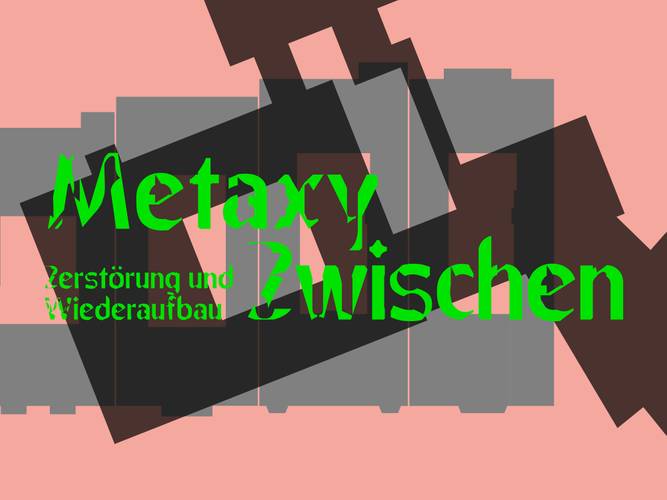
The project “Metaxy : Between Destruction and Reconstruction” begins precisely at this point, with an exhibition and a four-part programme of events. Metaxy, an ancient Greek word meaning “between”, refers to a space in which the past and the future, memory and new beginnings, as well as loss and hope, coexist. Reconstruction does not mean a return to a previous state but rather the uncovering of connections that have been torn apart.
Taking the Akademie building on Hanseatenweg as a prime example of post-1945 reconstruction, the exhibition presents an exploration of the colonial and Nazi history of Berlin’s Hansaviertel district and perspectives from Afghanistan, Bangladesh, Bosnia and Herzegovina, Germany, Israel, Palestine, Poland, Sudan, Syria, Ukraine, Yemen and the USA. The exhibition architecture itself is the project’s largest exhibit: It superimposes the site’s former buildings on today’s exhibition halls. This 1:1-scale palimpsest makes the history of the site tangible through the in-between space.
An event space forming part of the exhibition provides a venue for discussions, talks and artistic and musical performances. An educational programme featuring guided tours and lecture-performance walks, as well as a special issue of the magazine ARCH+, explores the exhibition’s themes in greater depth.
Participating artists and spatial practitioners:
Hala Alnaji, Archigrest, Marina Tabassum Architects, Maja Bajević, Karim Bingöl, Centre for Documentary Architecture, Kees Christiaanse, Tiffany Chung, CO-HATY, Salma Samar Damluji, Nir Evron, Ola Hassanain, Paul Hübner, Käthe Kollwitz, Anton Kolomyeytsev, Omer Krieger, Else Lasker-Schüler, V. Mitch McEwen, megouem, Kioomars Musayyebi, Marina Naprushkina/Neue Nachbarschaft Moabit, Open Group, Ute Richter, Nelly Sachs, Sasha Marianna Salzmann, Immanuel Schumacher, Arinjoy Sen, Nurit Stark, Syrbanism, Ernst Toller, topoScape, Kurt Tucholsky, Feda Wardak, Eyal Weizman, Ines Weizman, Julita Wójcik, Lebbeus Woods, Ina Wudtke
Curatorial team: Anh-Linh Ngo, Johanna M. Keller, Christian Hiller, Felix Hofmann, Markus Krieger, Daniel Kuhnert, Melissa Makele
Project management, Akademie der Künste, Architecture Section: Annette Maechtel
Exhibition architecture: ARCH+
Design: Zita Leutgeb, Olivier Therrien
Research assistant: Nicole Müller
Artistic and technical director: Roswitha Kötz
Planning and design assistant: Matthias Appelfelder
Coordination assistant: Carmen Abele
Price info: Disabled people and their accompanying attendant (with proper authorisation) receive free admission to the exhibitions and guided tours.