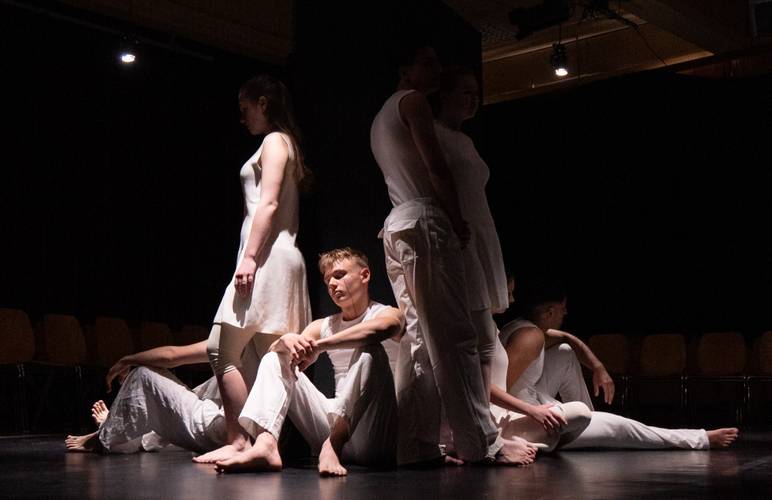
Peter Weiss’s The Investigation (1965) is based on the transcripts of the first Frankfurt Auschwitz trial. Across eleven cantos, the play traces the victims’ journey from the arrival ramp to the crematoria. This production of the first canto renders the mechanisms of violence, guilt and self-exoneration tangible through choral and physical language — and asks how hope can remain possible.
Production and Ensemble
Peter Weiss’s play The Investigation, first published in 1965, is based on the first Frankfurt Auschwitz trial, which took place between 1963 and 1965. Weiss attended the proceedings as an observer and developed the play from the trial transcripts. The result is a sequence of eleven cantos—so called because the language of the transcripts has been shaped into a rhythmic, almost musical form. Together, they symbolically trace the victims’ journey from the arrival ramp to the crematoria.
In each of the eleven cantos, the defendants, witnesses and prosecutors – the latter anonymised by Peter Weiss – confront one another. The text remains closely faithful to the historical sources. Weiss deliberately refrains from imposing an interpretative perspective, instead limiting himself to selecting, structuring and rhythmising the documentary material. This rhythmic form does not aestheticise the brutality of the testimony; rather, it lays it bare.
Our production focuses on the first canto – the Canto of the Ramp. It takes the form of a choreographic, text-reduced and choral interpretation. Carefully selected passages from the original text provide orientation around central themes such as accusation, guilt and denial. In doing so, the performance exposes mechanisms of self-exoneration and the relativisation of individual responsibility, while also asking where hope might still be found today in the face of these events.
The ensemble worked together for more than eighteen months, meeting primarily at weekends to rehearse. Finding the right tone and the right artistic language for this material became an essential part of the creative process. Ultimately, creating a work together that speaks to something of enduring relevance proved to be a deeply significant experience for all involved.
With and by
Pierre Azar, Gwen Bauer, Sophie Goppert, Jonathan Hau, Luisa Ott, Dominik Prade, Christa Röscher, Bastian Seelmann, Ivan Taran, Vincent Ummenhofer, Adrian Weigel, Tymofi Zahkvataiev
Philip Hemmer, Marek Rodatos – technical support
Marc Eichhorn, Jasmin Casimiro Ribeiro, Dominik Stoecker – directors