Come and celebrate with us 35 years of town twinning! Get ready for a wide-ranging German-Polish programme for all ages.
What links Berlin and Warsaw? What stories do we share, and what can we learn from one another? Together with Polish initiatives, Berlin-based communities and guests from Warsaw, we are celebrating 35 years of our town twinning in our three museums in the Nikolai Quarter. Discover your favourite spots, design your own ‘capital city’ bag, enjoy concerts, have fun learning Polish and discover lots more surprises in the programme!
PRICES
Combined ticket for all 3 museums: 15 euros
Single ticket for one museum: 7 euros
Concession: free of charge
Children: under 18s free of charge
The hands-on activities in the Museum
Laboratory and Salon at the Ephraim Palais, as well as in the Children’s Salon at the Knoblauchhaus, are free of charge for everyone.
PROGRAM
Ephraim Palace
11 a.m. – 4:30 p.m. | continuous | Museum Lab (ground floor)
Creative Workshop
Warsaw’s Mermaid meets Berlin’s Bear
Design your own capital city bag! Together, we’ll use stencils and fabric paints to transfer the landmarks of Berlin and Warsaw onto fabric. An artist and an educator from ‘SprachCafé Polnisch’ will guide you through the process and offer creative tips. At the end, you can take your bag home as a souvenir.
Free admission
Languages: German, Polish, English
11 a.m. – 4:30 p.m. | continuous | Salon (ground floor)
Hands-on Station
Warsaw – Berlin: A Collective Urban Mosaic
In what ways are Warsaw and Berlin similar today? Work with the founders of ‘Fundacja Puszka’ to create a map featuring unusual places and similarities between the two cities, and discover hidden treasures together. What feels familiar to you and is worth sharing? Are the same things important to you? And what does that tell us about these twin cities?
Languages: German, Polish, English
12:30 p.m. | Duration: 30 minutes | 1st floor (Room “1945”)
Performance reading
‘Kämpferinnen*’
For a long time, Polish women were largely overlooked in the fight against National Socialism. The artist and author Anna Krenz combines historical research, personal stories and artistic perspectives. She speaks of courage, solidarity and remembrance. Organised by the association Ambasada Polek e. V., this event forms part of the “KÄMPFERINNEN*” project on Polish women in the resistance.
Language: German
Part of the anniversary programme “Between Berlin and Warsaw – 35 Years of Neighbourhood”, coordinated by the German Poland Institute and funded by the German Class Lottery Foundation Berlin (LOTTO Foundation Berlin).
11 a.m.–2 p.m. | continuous | Salon (ground floor)
Talk
Object of the Month
Discover the beaker, made around 1840, featuring an image of King Friedrich II. The design is based on an etching by Daniel Chodowiecki from 1777. He was one of the most significant Berlin artists of his time. To mark the 300th anniversary of Chodowiecki’s birth, our curator of fine art, Michael Bischoff, will tell you more about his work.
Free admission
Language: German
2:00 p.m. | Duration: 1 hour | Meeting point: Foyer (ground floor)
Family tour
A whirlwind tour through BerlinZEIT
This family tour takes you on an easy-to-follow and entertaining journey through the permanent exhibition on the history of Berlin. Along the way, you’ll have plenty of opportunities to try things out and experience them with all your senses. What did medieval fabric feel like? What did Berlin smell like around 1740? And which new inventions made everyday life in the big city easier?
Language: German
5:30 p.m. | Duration: 45 minutes | Salon (ground floor)
Presentation
Skyscrapers and Thickets
For the past 15 years, ever-taller skyscrapers have been springing up in Warsaw. The city is changing. Anyone wishing to understand it should explore the banks of the Vistula, the Finnish wooden houses in the Jazdów district or the giant artificial palm tree at the Charles de Gaulle roundabout. Urban researchers Aleksandra Litorowicz and Martyna Obarska from Warsaw’s ‘Fundacja Puszka’ highlight phenomena, developments and art projects that bring this transformation to life.
Free admission
Language: English
St. Nicholas Church
11 a.m.–3 p.m. | continuous | Meeting point: Baptismal font
Family & Children
Family-Rally
What do the colours on the ceiling mean, and what are the oldest bricks in the Nikolaikirche called? Look for clues and hints inside the church to solve the puzzles in the family treasure hunt. There’s a prize waiting for you at the end!
Languages: German, Polish, English
3:00 p.m. | Duration: 30 minutes | in the nave
Concert
Warsaw and Berlin in song
The German-Polish choir ‘Spotkanie’ from Berlin brings people together through songs about their love for both cities and their longing for the charm of bygone days. Founded in 1989, the choir is led by singer and ethnomusicologist Dr Izabella Goldstein. ‘Spotkanie’ means ‘encounter’, and that is precisely what it is all about: Poles and Germans coming together through singing.
Languages: German, Polish
4:15 p.m. | Duration: 45 minutes | in the nave
Concert
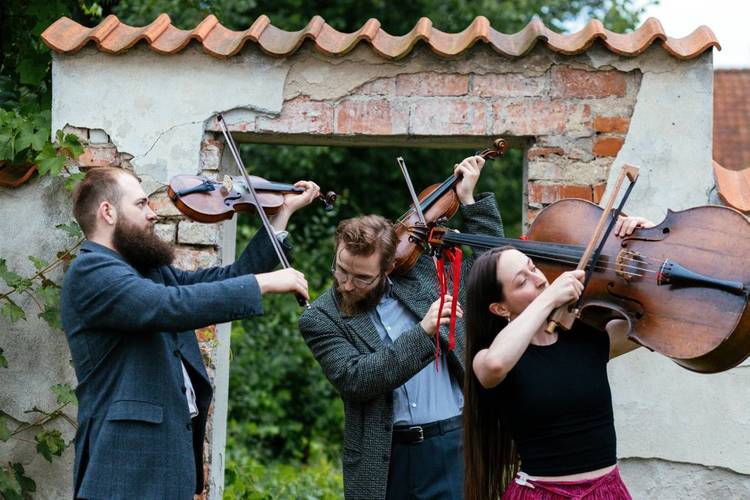
Traditional Polish dance music
‘Kapela Agopsowicza’ from Warsaw brings Polish folk dance music from the countryside to Berlin – featuring mazurkas, oberkas, polkas and singing. The young musicians have learnt from masters of the rural musical tradition and are carrying on this heritage with great enthusiasm. Following performances in Poland and across Europe, ‘Kapela Agopsowicza’ is now playing in Germany for the very first time!
Languages: German, Polish
A collaboration with the Polish Institute in Berlin
Knoblauchhaus
11 a.m.–4 p.m. | continuous | Children’s Salon (ground floor)
Hands-on activity
Polish Language Lab
Games, puzzles and tongue twisters for all language levels
What does Polish sound like, and how much of it do you already understand? Pupils and teachers from the Berlin school association ‘Oświata’ have a variety of language games and exciting activities in store for you. Whether you’re hearing Polish for the first time or grew up bilingual: everyone can join in here, discover new things and experience just how much fun language can be.
Free admission
Languages: German, Polish, English
In cooperation with KoKoPol – Competence and Coordination Center for Polish
11 a.m.–4 p.m. | continuous | in the exhibition (1st and 2nd floors)
Live Speaker
Biedermeier Meeting Point
At the Knoblauchhaus, our museum educators will give you exclusive insights into the daily life of Berlin’s wealthy residents two hundred years ago. Through the silk trade, architecture, and their own brewery, the Knoblauch family played an important role in Berlin at that time. Today, you can explore their former home as a museum.
Language: German
11 a.m.–4 p.m. | continuous | in the exhibition (1st and 2nd floors)
Family & Children
Family Scavenger Hunt
What did children play with 200 years ago? How did people keep warm in winter? And what was actually “in” back then? Clues and hints throughout the museum will help you solve the puzzles of the Family Scavenger Hunt. A prize awaits you at the end.
Languages: German, Polish, English
Partners
German-Polish Institute
The German-Polish Institute is a center for Polish history, politics, culture, society, and German-Polish relations. Through its programs, it brings people—especially in Germany—into contact with Poland and Polish topics.
Fundacja Puszka
Since 2010, the Warsaw-based Fundacja Puszka has been inspiring people to discover the city and experiment with it. It focuses on urban culture and public space, launching and supporting projects related to art, architecture, design, and biodiversity. It also conducts research on public space and carries out educational projects and publications.
Ambasada Polek e.V.
Founded in 2022, the association Ambasada Polek e.V. focuses on women’s history, art, culture, and German-Polish relations. It brings people together—regardless of their gender, nationality, or faith. In its projects, the association combines remembrance with contemporary art and cultural work, for example through city games, audio walks, exhibitions, educational programs, and research projects.
KoKoPol
The Polish Competence and Coordination Center (KoKoPol) is committed to helping more people in Germany discover, learn, and speak Polish. In this way, the center aims to strengthen exchanges with our neighboring country, Poland, and further advance cooperation in Europe.
Polish Institute Berlin
ThePolish Institute in Berlinis part of the Ministry of Foreign Affairs of the Republic of Poland. It works to raise awareness of Polish culture and topics in Germany. The goal is not only to promote culture but also to spark an interest in Poland—in its way of life, its people, and the many fascinating aspects of our neighboring country.
School Association
The Polish school association Oświatain Berlin is independent and politically neutral. For over 35 years, it has been committed to promoting the Polish language and culture and helping young people forge a stronger connection to the homeland of their parents and grandparents. Through Polish language classes and cultural events, the association enables children and teenagers to further develop their language skills, learn about Polish history and traditions, and strengthen their Polish identity.
Polish Language Café
Thisnonprofit meeting placefor culture, language, and business organizes workshops, cultural events, and community initiatives in Pankow, Schöneberg, and Köpenick with a Polish flair and an open heart. These events bring together long-time and new Berliners with people from all backgrounds.
The German-Polish Society Berlin e. V.
For over 50 years, the association has been helping residents of Berlin and the surrounding area learn more about neighboring Poland—its people, history, and culture. Through its own projects and collaborations, it supports Berlin’s city partnership with the Polish capital, Warsaw, as well as the many municipal partnerships between Berlin’s districts and Polish cities and towns.
Media partners
Himbeer – Berlin with Kids
Address
Nikolaiviertel
10178 Berlin
Translated with DeepL